Monday, July 02, 2007

I'm Back/Literary Adaptation Review #1

I know it's been a long time since I've updated — but I think one of the reasons I haven't is I intimidated myself with my highly-organized movie review system. It's a nice idea to have all those stars, but I don't know how practical it is for someone with my less-than-organized brain.

So, I am going to start reviewing literary adaptations, and likely I'll cover many of the points on my Checklist 'O Fun, but don't expect to see fancy charts, OK?
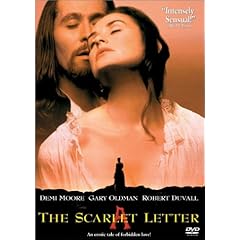

First up is 1996's The Scarlet Letter starring Demi Moore as Hester Prynne, Gary Oldman as Arthur Dimmesdale and Robert Duvall as Roger Chillingworth.

You may recall in my review of the book I referred this adaptation as "the trashy Demi Moore movie". That was based on my recollection of one viewing more than 10 years ago. I recently had a chance to see this film again and my perspective on it has definitely changed. To be sure, it still completely misses the point of the book — but I did find a little bit more to like about it in this go-around.

Books and film are different mediums. I have no real objection to the movie starting a year or two before the book's action begins. In fact, I rather liked seeing Hester and Dimmesdale getting to know each other. The look on his face when he finds out the pleasant young woman he was flirting with in the forest is actually a married woman — and therefore out of his reach — is priceless.

Part of what makes the book great is that we don't find out immediately who the father of Hester's illegitimate child is. I missed the "forest" scene that comes midway through the book and finally makes it clear Dimmesdale is Daddy. I understand, though, the literary tricks that make that scene great would be impossible to translate to film.

There was just enough retained from the book's opening scene, where Hester faces the public humiliation of receiving her Scarlet "A" (for Adultery) at the town stocks, to tantalize me. That scene, where the Rev. Dimmesdale speaks from above, entreating Hester to name the father of her child for his own good, is one of the most powerful that I've encountered in literature. Of course, a first-time reader may not realize that he's talking about himself. When Gary Oldman gave the highly-abbreviated version in the movie, it was still a meaningful scene — but not quite what I was hoping for. And, of course, having seen him and Hester literally rolling around in the hay together, we were all already clued in that he was Pearl's father.

So, that's the good. (Or, at least, the "not bad.") Now, what was still downright laughable/awful?

Lisa Joliffe-Andoh's mute slave girl character, Mituba — WHAT??? What did she contribute to the story? She's not in the book. Yes, we all got the P.C. reminder that Puritans kept African slaves — but this character was just awful. All she did was spy on Hester in compromising positions and giggle like a madwoman. Don't even talk to me about the candle scene. How creepy.

Robert Duvall's portrayal of Chillingworth — Again, WHAT??? How did a nice character actor like Robert Duvall get suckered into a goofy role like this? Yeah, Chillingworth was a little over the top in the book too, but he didn't go around jumping off big rocks and scalping people. In the book, he waited seven years to get his revenge through "scientific" means. He was "chilling" because he was so tightly reined in, not because he was certifiably bonkers.

The Native American war sub-plot — This was another thing that feels like it was in there because it was made in the 90's and we have to be acknowledge that these Puritans have taken over lands that belong to someone else. OK, point taken. I was kind of intrigued that Dimmesdale was trying to translate the Bible into Algonquin (Although did Algonquin even HAVE a written language back in the 17th Century?) But most of this plot just seemed to have nothing to do with anything else — and the final scene made no sense at all.

The Steamy Scenes — Granted, if there wasn't some adulterous sex going on, there wouldn't be much of a story. But did we really need the bathing scenes? Any of them?

And finally...

It misses the point — Ultimately, the story of The Scarlet Letter isn't "an erotic tale of forbidden love," as the movie poster tagline says. It's about hypocrisy and the hidden effects of guilt. Once she receives her "A", Hester's conscience is clear. She can't hide her sin, it's right out there in front for everyone to see. She is able to build a new life starting from scratch, until, at the end of the book, people don't even remember what the "A" originally stood for.

That doesn't happen to Demi Moore. She's too busy whining about equality and fair treatment for women.

Dimmesdale's story is supposed to be the exact opposite. He carries the same guilt around as Hester does, but he's too much of a coward to reveal it and face the public disgrace he knows would follow. He wants Hester to rat him out, but she absolutely refuses. But, with no way of relieving his secret, he grows more and more frail over the years as his conscience gets the better of him.

That didn't happen in the movie either. In the film, it's Hester that stops him from telling everyone he's the father. He's in a hard place, to be sure, but he still gets to drive happily away into the sunset at the end of the picture.

That ending left me feeling robbed, and that I hadn't just spent the last couple of hours watching the "real" Scarlet Letter.

Labels: , ,

Friday, April 20, 2007

Why I reread...

"Some books are so familiar, reading them is like being home again."
- Jo March (played by Winona Ryder)
in the 1994 "Little Women" movie

Labels: , ,

Saturday, April 14, 2007

Literary adaptations

In addition to books, I thought it might be interesting to begin reviewing my favorite films, shows etc. that are based on books and plays (can't leave out Shakespeare).

Now, some of these works are simply great adaptations. They faithfully tell a story I happen to already love. Others are great in their own right... And then there are the Holy Grail of literary adaptations... Works that are both.

To get started, I've come up with a set of criteria to help me analyze each:

The Poohba's Bibliotèque Literary Adaptation Four-Star System

Actors match character description (Possible ****)
This means just that. The director has not chosen a tall, slim redhead with an American accent to play the slightly pudgy, dark-haired heroine of your favorite Australian novel. This category also will comment on casting choices that seem too "modern" for historical roles.

Plot follows story (Possible ****)
Another no-brainer category. Does the script play fast and loose with what happened in the book? I don't want to see Anne of Green Gables running around France during World War I when anyone who has read Rilla of Ingleside would know how ridiculous that is.

Additional material adds to the established story without contradicting "canon" (Possible ****)
This is very closely related to the category above, but I think it deserves a rank of its own. Adapting art from one media to another can be messy. This is meant to reward films that bring something extra to the table. If a filmmaker adds a scene (or plot point or two), or successfully condenses material that would make a movie too long, all without deviating from the spirit of the original, then they deserve a pat on the back.

Overall faithfulness to the story (Possible ****)
This category takes into account the scores from the first three, as well as my overall impression of whether the spirit of the original work is upheld.

Poohba Entertainment Factor (Possible ****)
Forget the original. Was this a good movie, play etc. in its own right? Would I enjoy it if I hadn't read it first?

Labels: ,

Tuesday, April 10, 2007

Musical inspiration


I watched The Sound of Music the other night. What a great movie. A little cheesy, yes, but good.

I'd never really thought about it before, but it also inspired a few scenes in Thorn of the Kingdom. Remember where Abby sneaks into the open ballroom and begins dancing with an imaginary partner? I doubt she would have if Julie Andrews hadn't first.

Actually, the ballroom at Tholly's palace isn't so far off from the one at the von Trapp Family villa. It's just bigger, of course, and with a bit more of the colors you'd find at Beast's castle.


It's strange to realize how all these little bits can get stirred up in one's mind and come out in different ways. It's not plagiarism. It's just how art works and has always worked. Ask Shakespeare.

Labels: , , , , ,

Monday, March 12, 2007

Unfinished books


Here's an interesting article on the books Britons are most-likely to buy, but not read all the way through.

It got me to thinking about what books I've started and have just not been able to slog my way through to the end. Two that immediately came to mind were Little Women and The Secret Garden. I have read both of them all-the-way-through now - but it must have taken at least a half-dozen attempts for each one.


The funny thing is, I loved the opening chapter of both of them. I would read the opening chapter with enthusiasm. And then I'd get to chapter 2, which wasn't so great (IMHO). I might push myself to read chapter 3 - but that would be about it.

For years, these books haunted me. I could not get through them. I did finally read Little Women after the Winona Ryder movie came out. I absolutely loved the movie and that gave me the courage to attempt the book again. I read it, enjoyed it, and moved on to Little Men and Jo's Boys. Though - it may be worth noting that I've never attempted a re-read of them.

I did not get around to finishing The Secret Garden until last year - when I resolved I was going to get through all those books in the back of my closet if it killed me. I didn't think much of it, and soon got rid of the copy I'd been holding on to for all those years. However, I also discovered Heidi in my closet-raid, and thought that was a fairly good children's book - even though I'd never given it much of a fair chance when I was a kid. It's funny that I didn't like The Secret Garden, though, because I always loved the first chapter - and Frances Hodgson Burnett's A Little Princess was one of the seminal books of my childhood. (I wrote many a piece of juvenilia involving orphans and cruel boarding schools after reading that novel.)

But, I guess that's the reading life. You win some, you lose some.

So, what are some books that you could never get through?

Labels: , , , , , ,

Wednesday, January 24, 2007

Jane Eyre

Since Sunday, I've been wondering how long I can stand it before I reread Jane Eyre. I read it once, in high school, and didn't much care for it - despite the glowing recommendation of my mother. She's pretty much a non-reader, but she loves Jane.

I, however, didn't much care for the book, and didn't really care for the movie version I saw once either. Only Jasper Fforde's silly take on it has ever piqued my interest.

However, the new Masterpiece Theatre version has me hooked. I know how it ends - and I still can't wait until the conclusion airs.

Labels: , , , ,

Thursday, October 26, 2006

Gone With the Wind by Margaret Mitchell


Loved the movie. Loved the book. This is well worth the read, even if you've seen Clark Gable tell Vivian Leigh that he "doesn't give a damn" about a million times.

(And, if you've never seen the movie... Go rent it this instant! It's a movie that has aged much better than most Hollywood epics of the studio era. I was really surprised by how sophisticated a movie it still is the first time I saw it.)

Labels: , , , , ,

Thursday, October 05, 2006

Much Ado About Nothing by William Shakespeare


While we're talking plays, I might as well mention my favorite Shakespeare. Again, I have to recommend the movie version. If you haven't seen the Kenneth Branagh and Emma Thompson version, you need to. It's the movie that made me "get" Shakespeare for the first time and now I'm as nutty a Shakespeare nut as they come.

Anyway, the play:

Beatrice and Benedick have always hated each other. They have a war of words every time they meet.

So, of course, their friends and relatives decide they'd be perfect for each other and come up with a hysterical way to set them up! It doesn't prove too hard to do, of course. Maybe they didn't hate each other as much as they thought they did.

There's a few other plots running through (after all, it is Shakespeare), but Beatrice and Benedick are the reason to read this play. They're as witty and fun as old B.S.* gets.

(* "B.S." stands for "Bill Shakespeare." It's what my old high school English teacher used to call him.)

Labels: , , , ,

Cyrano de Bergerac by Edmond Rostand


Actually, this is a play... and perhaps the best story of unrequited love on record. I highly recommend the Gèrard Depardieu film version.

Cyrano is lover, poet and a fighter, but he's just too scared to tell the beautiful Roxane how he feels about her. Meanwhile, he's helping a much more handsome man woo her with the words of love that spring from his own heart. When Roxane confesses she's fallen for the poet, and not the pretty face, Cyrano may have some 'splaining to do.

It's sweet and tragic. Man, I seem to be on a "sad endings" kick tonight. Kleenex anyone?

Labels: , , , ,